Friday, September 15, 2006

Description of the inauguration of John Lee Carroll

Historical Context: Thomas Sully's portrait of the aged Charles Carroll has hung in the Maryland State House since 1834. It now hangs in the New Senate Chamber.

Source: The New York Times, January 13, 1876, p. 5.

Gov. Carroll of Maryland
Annapolis, Jan. 12--John Lee Carroll was inaugurated Governor of Maryland to-day in the Seante Chamber, in the presence of both Houses of the Legislature and the Judges of the Court of Appeals. The oath of office was administered by Chief Justice Bartol. Gov. Carroll is the grandson of Charles Carroll of Carrollton, a signer of the Declaration of Independence, and is the thirty-seventh Governor of this State. . . . Many ladies and distinguished gentlemen were present, among them State Senators Bayard, of Delaware, and Dennis of Maryland; also, Mayor Latrobe, of Baltimore. The band from the Naval Academy furnished the music. A full-length portrait of Charles Carroll of Carrollton, by Thomas Sully, looked down upon the scene. It is probable that no more brilliant assemblage has gathered in the old Senate Chamber since the day George Washington resigned here his commission of Commander in Chief of the American Army on the 23rd of December, 1783.

Labels:

John Lee Carroll & Jousting


Believe it or not, jousting was made the state sport of Maryland in 1962. Though jousts were held in Maryland and Virginia since colonial times, the era of modern jousting in Maryland began with William Gilmor (of the family that would produce famed cavalryman, Harry Gilmor.) Gilmor had witnessed the famed Eglington Tournament in Scotland in 1839 and in the following year, hosted a tournament at his estate outside Baltimore. Tournaments were held at Doughoregan when the Carrolls were children, and the sport was ideal for Marylanders who cherished the novels of Sir Walter Scott and the notion of the knightly chivalry. The language of chivalry was repeatedly used throughout the Civil War; for example, Harper's commander, Jeb Stuart, was referred to as the "plumed knight" for the feather in his hat. So great was the infatuation of the southerner with Scott's "dreams and phantoms" that Mark Twain claimed there would not have been a Civil War without him. The tournaments became especially popular in the South after the Civil War as a way of honoring the Confederacy and what the "knights in gray" perceived to be the ideals that motivated that war.

Labels:

Tuesday, September 12, 2006

China from John Lee Carroll winds up with descendant of Patrick Henry

Historical context: This article was on a web site called "Richmond Then and Now" and does not give the date of the article's publication. The oldest Thompson girl, Margaret, married Paul Jones Carrington, and this may be how some of the Carroll china wound up with the Henry/Carrington family.


Richmond Times-Dispatch Circa 1935
Antique Secretary Was Desk of Patrick Henry

Antique Secretary Was Desk of Patrick Henry
By Jay-Bee

Antique Virginian furniture, as such, "just ain't" quoths our Franklin Street dealer-collector, "for the reason that Virginia was an agricultural settlement and not given to the handicrafts," but---,Few indeed are the persons, however much they may be sticklers for authenticity, who would deprive a cherished possession of Patrick Henry of the right to assume the title of "Virginia antique." Such historic lineage carries with it the same sort of poetic license which countenances the bestowing of the "colonel" and "captain" flourishes so dear to our Southern salutatorians.
All of which is merely by way of introduction to an old, old "secretary" or combination writing desk, bookcase and drawers which is housed under a Richmond roof, the possession of descendants of the great orator and patriot.
(I have omitted details of the furniture)
Alexander Spotswood Henry, son of Patrick Henry, inherited the secretary from his father, and it remained in the Lynchburg home of the former for several decades. Later it passed to Alexander's daughter, Sarah Winston Henry, who became the bride of Dr. George Cabell Carrington of Halifax Courthouse, Va.
Now it is the prized possession of Mrs. Richard Bruce Carrington of 1008 West Forth-third Street, Forest Hill, widow of the great-grandson of Patrick Henry.
Old China From the Baltimore Carroll's
Mrs. Carrington uses the bookcase of the old secretary to display to advantage some rare old china plates which came into her possession from the estate of former Governor John Carroll of Maryland. The old plate was made in England and carries the old English "C" of he Carroll name prominently in the center of the pieces. . . .
Other relics of the famous Henry and Carroll menages which have come down through the years to Mrs. Carrington include some valuable old portieres which she is still using in her Forest Hill home, and some rare and ancient chinaware depicting Martha Washington and Mount Vernon in delicate colors.

Labels:

Monday, September 04, 2006

John Lee Carroll Letter 1847

(The letter covers four pages and I have not scanned it in, though I can do so if any family members wish to see the original.) Source: Mount St. Mary's Unversity, Special Collections.
The "high spirits" to which Col. Carroll refers are very apparent in this letter to a friend back at Georgetown, where he had earlier attended. It was written very near the end of the school year and because it is still at Mount St. Mary's, it was either confiscated by Rev. McCloskey, who read all letters going out and coming in, or it simply did not have time to pass the censor. There were censors also at Georgetown, and these seem to have intercepted earlier letters. The "spree" at Frederick to which he refers may have been planned for Carollton Manor, one of the family homes in that area. Premiums are awards for scholarship. The "stalls" appear to be outhouses. The fellow who went to Mexico fought in the Mexican-American War which took place from 1846-1848.

Mt. St. Mary's June 26th 1847

My Dear Alf
Hitherto I have thought it utterly useless for me to write to you, as I have writtten some 4 or 5 and received but 2 from you. The conclusion I came to was that they had not given you my letters at Georgetown, but I did not suppose that you did not answer them. However as it is near the end of the year I suppose they will not again interrupt the correspondence which we intended so regularly to continue. I have a great deal to tell you when I see you, but which I could not mention to you now as it would fill up the letter too quickly. I will certainly see you at the Exhibition to which I would not miss coming for anything. I expect to have a spree of the same sort as last year's if not a little better. Our vacations begin on the 30th of this month which is only 3 days off. A party of 8 or 9 of us are going to Frederick that night where we intend having a pretty smart spree & taste a little of everything. I suppose you know before this that Charles has left. He went away in March under a plea of bad health but always was as hearty as a buck. From his letters he appears to be playing the mischief among the ladies, which appears to be contrary to his nature. Alf, I would not for anything miss coming back here next year. I have got along first rate and can get nearly any privilege just by asking for it. I have some very fine companions with whom I spend all my time and spend it very agreeably, and I get a smoke of good segars 2 or 3 times a week. I suppose you fellows still keep up our old practice of smoking in the stalls, it used to go very fine with me. When you write do not forget to tell me how old Kent spoke on the 22nd of last Feb. as I have not heard from you since that time. I wish you had sent me a copy of the speeches of both societies. I got a very unexpected letter from Swift the other day who gives me a great account of his dealings with the folks of those parts. He says it is a splendid place and he enjoys himself very much.
My examination is all over and I never in my life stood such an easy one. It is not to be compared with the Georgetown examination in strictness or anything else. Unfortunately they say I have come here too late to get premiums; if it were not so I would feel pretty flat as I did not expect more than 2 or 3 and they are nothing for this place where they give out about 250. I suppose you and Bat go out swimming in order to keep up the remembrance of our old and favourite ways of breaking the rules. They do not (as I believe I before told you) force you to go to confession here, and as they did not make any fuss about it I made my Easter with great ease but have not owing to various impediments been able to bring my self up to the bull ring since. I have written once or twice to F. ? Hall but have only heard from him once and that was before he left George(town). Mr. Roura? I believe is coming up to play at the Exhibition; we will I think have some splendid music that day. They not long ago introduced us in new and splendid stalls with delightful holes and everything convenient. I wish you could enjoy a seat on them, this is about the most novel incident of late and I thought I would inform you of it. I know some very fine girls around the country but whom of late I cannot get to see as frequently as formerly. I occasionally hear from old major in B(altimore). He is I am inclined to think not doing much more than spreeing. I hear old Ned Donaldson (you recollect him) after having run away from his mother went to Mexico and they say fought like a tiger, and has now come back covered with glory. Nelson just tells me he received a letter from you yesterday; he says he thinks he will go to the Exhibition also. If so we will have a very pleasant time. I suppose you will not come round by Baltimore on your way home, if you can we can have some fine fun. There is nothing new here and so I must bid you adieu until I get home. I remain your sincere friend.
John Lee Carroll
when you write direct your letter to the care of Charles Carroll Esq near Ellicotts Mills, Howard Dist. M-D
give my respects to Wade Bat and all those old fellows

Labels:

Sunday, September 03, 2006

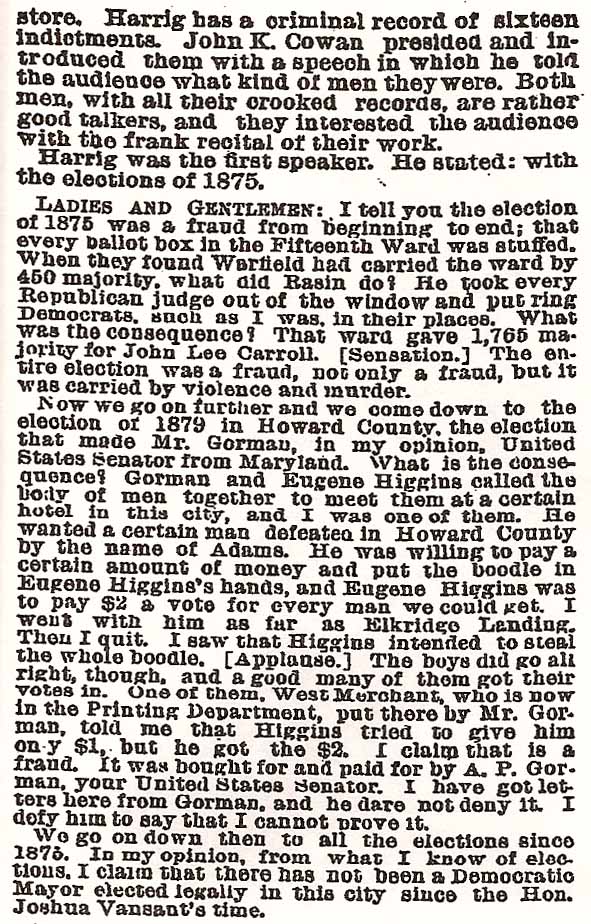
Confession of Ballot Box Stuffer in 1875


The New York Times, October 28, 1889, p. 5. The headline in bold print for this article was "BALTIMORE IS STIRRED UP". This political rally was in support of John K. Cowen, a Maryland Congressman who was making an ultimately unsuccessful attempt to unseat Senator Arthur Pue Gorman. His tactic was to paint Senator Gorman as the boss of a corrupt political machine, and he reopened old charges of irregularities in the governor's race of 1875. William F. Harrig was a former Confederate soldier in the 1st Regiment of Virginia Artillery and at the time of his confession, the holder of a minor political office he claimed was his reward for voter fraud and intimidation in both the governor's race of 1875 and the 1879 Senatorial race which Gorman won. Cowan, upon introducing Harrig, acknowledged that he had a criminal record of sixteen indictments.
The "Rasin" referred to is Isaac Freeman Rasin, the Democratic political boss of Baltimore. Considered the most powerful machine boss during his lifetime, it would have been impossible for John Lee Carroll to win the governor's election without his assistance. As a reward for his efforts in getting Grover Cleveland elected president, Rasin was given the lucrative post of Naval Officer of the Port of Baltimore.

Labels:

Reconciliation of John Lee Carroll and Senator Gorman

The Washington Post, July 29, 1898, p. 3. The Congressman against whom John Lee Carroll was thinking of opposing was Sydney Emmanuel Mudd. Perhaps Mrs. Carroll's poor health or the Governor's own estimate of the inability of a Democrat to win in the 5th district deterred him from making the race for Congress. Sydney Emmanuel Mudd won the race and remained in office until his death in 1911.

Labels:

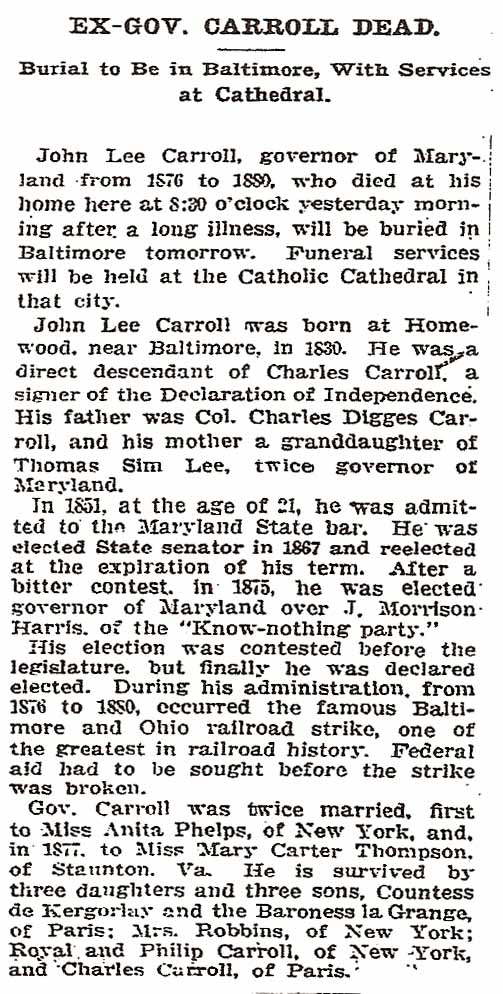
Death of John Lee Carroll


The Washington Post, February 28, 1911, p. 2.

Labels:

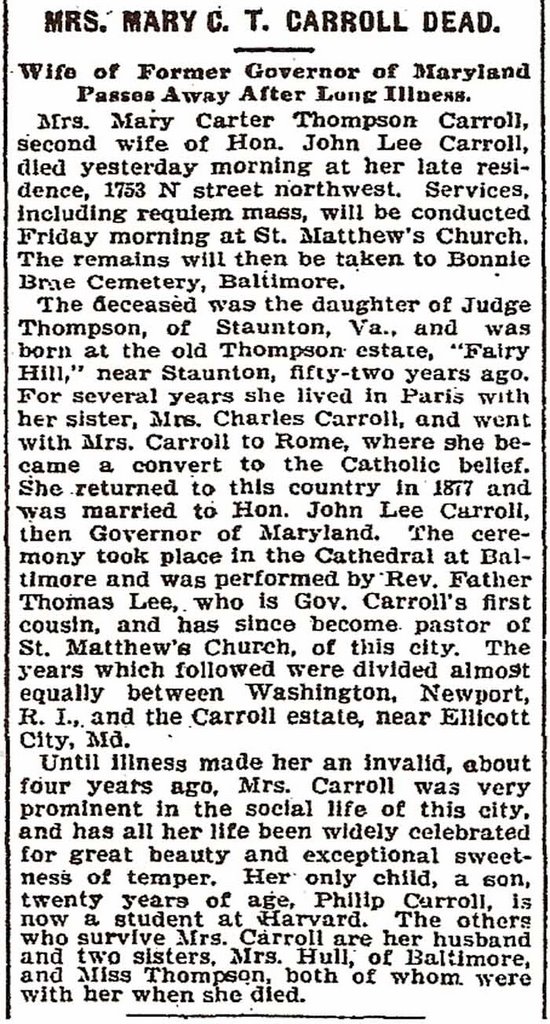
Death of Mary Carter Thompson Carroll


March 8. 1899, p. 2.

Labels:

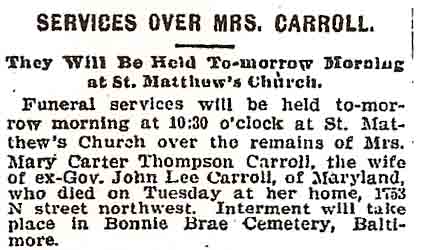
Funeral Announcement for Mrs. Carroll

The Washington Post, March 9, 1899, p. 2.

Labels:

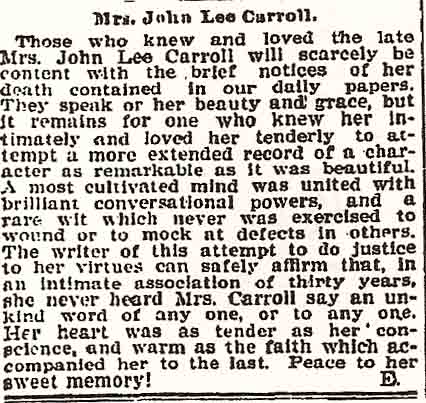
Tribute to Mary Carter Thompson Carroll


The Washington Post, March 13, 1899

Labels:

Saturday, September 02, 2006

John Lee Carroll on horseback


New York Times, August 24, 1890, p. 9.

Labels:

John Lee Carroll & Democratic Politics in 1880

The disputed election to which the platform refers is that between Democrat Samuel Tilden and Republican Rutherford B. Hayes. The Congress awarded the election to Hayes in order to broker a deal for the end of Reconstruction in the South.

Labels:

Friday, September 01, 2006

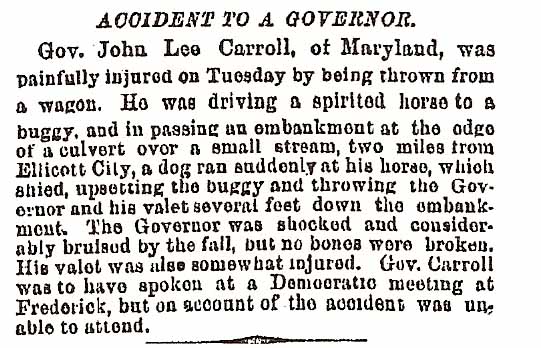
John Lee Carroll's carriage accident 1876


New York Times, October 27, 1876 p. 2.

Labels:

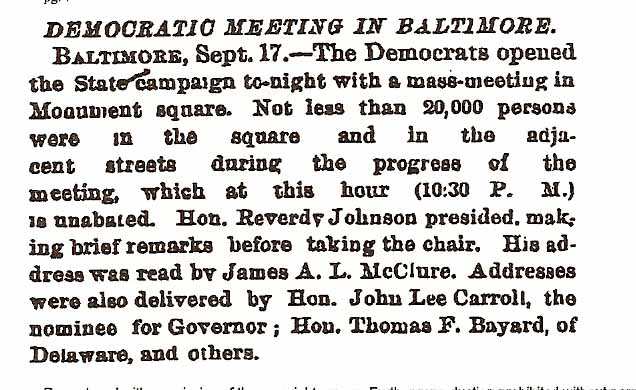
John Lee Carroll's campaign 1875


New York Times, September 18, 1875, p. 7. Reverdy Johnson, a Baltimore attorney who had worked with Judge Roger B. Taney and was influential in the Dred Scott case, spoke in favor of John Lee Carroll at this vast assembly. Johnson, who had one of the most checkered political careers in American history, had served as a United States Senator from Maryland from 1863-1868. During this time he defended Mary Surratt, who was ultimately hung as a conspirator in the Lincoln assassination, and offered his services to Jefferson Davis and Robert E. Lee if they were accused of treason. Johnson had been ardently opposed to the anti-Catholic Know Nothing Party, and insisted to Marylanders that they should not vote against Carroll because he was Catholic.

Labels:

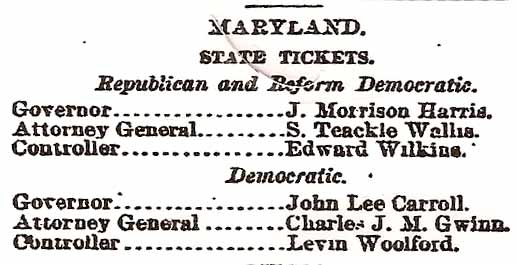
Maryland State Politics 1875


Severn Teakle Wallis was one of the Maryland State legislators locked up in 1861 to prevent secession and taken to Fort McHenry and Fort Warren with several Howards and with Robert Hull, husband of Susan Thompson Hull. After the war, his politics must have changed. It was this family that produced Wallis Simpson, the woman who brought down the throne of England.

Labels:

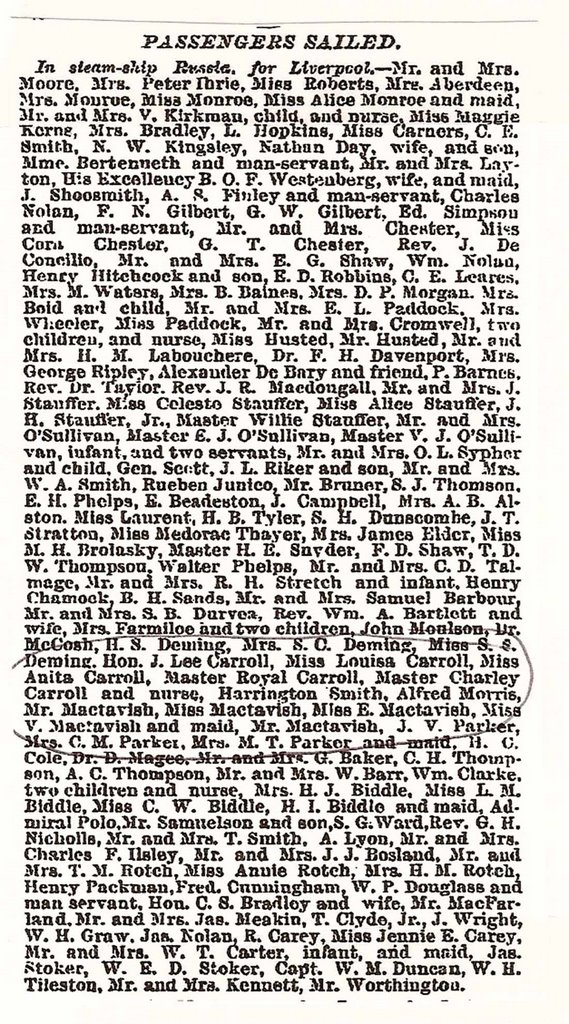
John Lee Carroll and family to Europe in 1874


From the New York Times, July 2, 1874, p. 8. On the MacTavish sisters who sailed with them, see post below.

Labels:

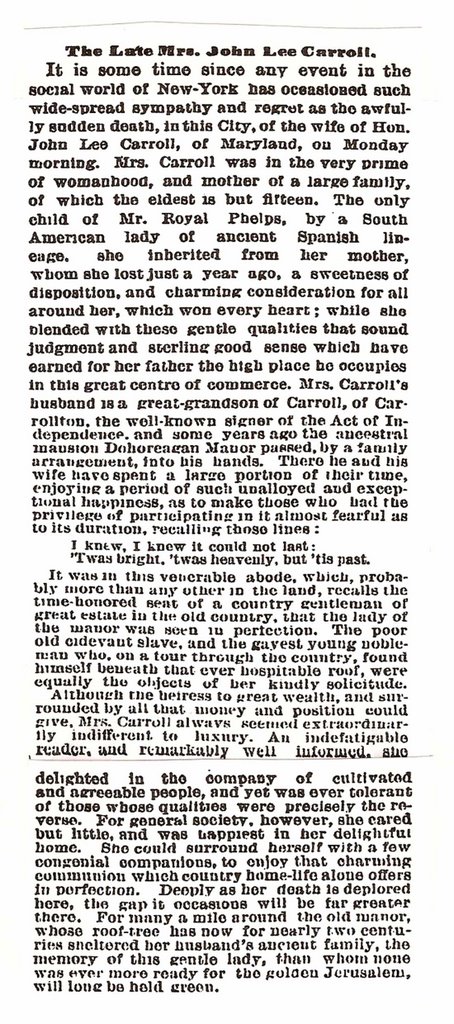
Death of Anita Phelps Carroll (March 24, 1873)


(To increase the size, click on the picture then click again when the magnifying glass appears.) New York Times, March 27, 1873, p. 2. Anita Phelps was the daughter of Royal Phelps of New York City and the mother of eight children. The article identifies the youngest child as being 15, but that child was Mary Helen Carroll, born the day her mother died.

Labels:

John Lee Carroll at the Catholic Club 1892


New York Times, October 12, 1892, p. 2.

Labels:

Elkridge Fox Hunting Club


From New York Times, November 20, 1892, p. 12. The Elkridge Fox Club was established in 1878 and composed of the oldest and most prominent families of Baltimore. In 1894, the Club would begin the Maryland Hunt Club Steeplechase.

Labels:

Carrolls in Washington Society


Jerome and Charles Bonaparte were friends with the Carroll family, and had been since their grandmother, Elizabeth (Betsy) Patterson had married Jerome Bonaparte, youngest brother of Napoleon Bonaparte in Baltimore in 1803. The marriage was presided over by Archbishop John Carroll. Betsy Patterson was the sister-in-law of Marianne Carroll Patterson, a grandaughter of Charles Carroll of Carrollton, who would later marry the Marquess of Wellesley. Napoleon forced his brother to make a dynastic marriage, and refused to recognize Betsy or her son, Jerome, born in 1905. Betsy, the daughter of William Patterson, the wealthiest man in Maryland after Charles Carroll, split her time between Europe and Baltimore for much of the rest of her life. Her grandchildren were recognized by Napoleon II, the nephew of Bonaparte, and Jerome served in the French imperial army before returning to Baltimore after the fall of Napoleon II. Clipping is from the New York Times, February 15, 1893, p. 5.

Labels: