Tuesday, September 05, 2006

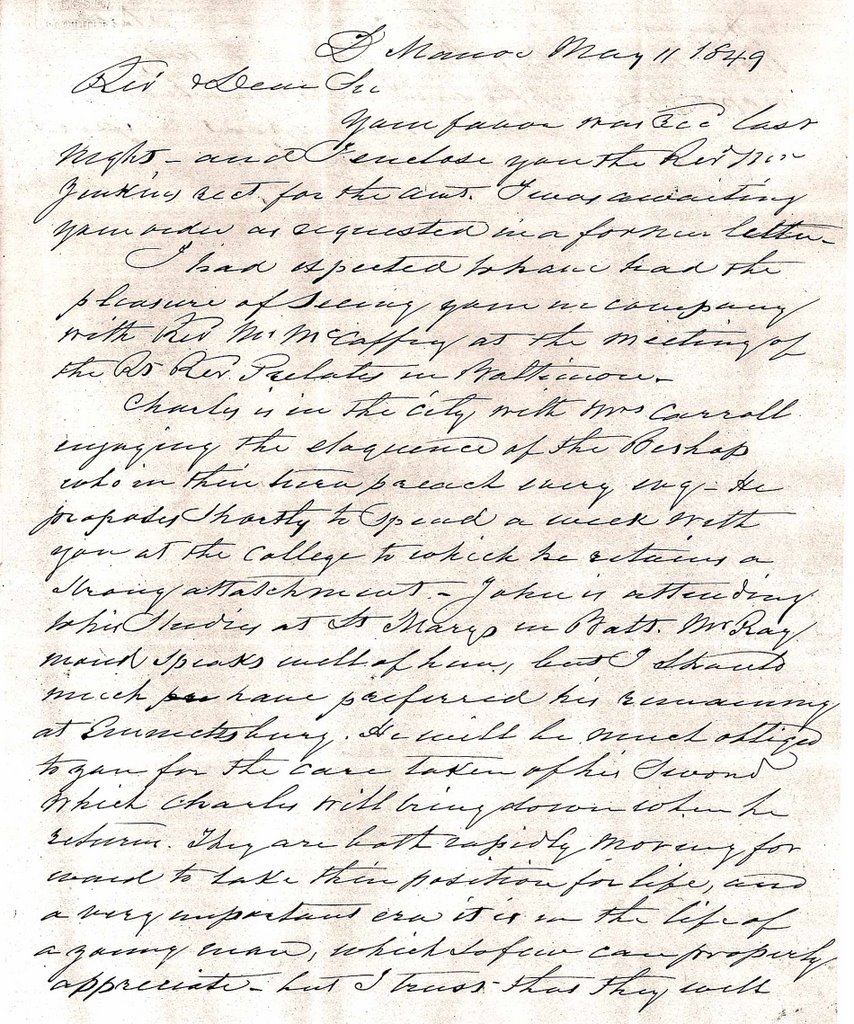
Charles Carroll letter May, 1849


Source: Rev. John McCloskey letters, Special Collections, Mount St. Mary's University. Both John Lee and his older brother Charles had been students at Mount St. Mary's. There is no record of either Albert or Harper having attended, despite their father's great affection for his alma mater. Both of the older sons elected to leave before graduating. Charles does not appear to have carried his education further, while John Lee returned to the school of his youth: St. Mary's in Baltimore. The "order" that was in charge of Mount St. Mary's was the Society of St. Sulpice, to which the Carroll family had been long devoted. The sword referred to belonged to Colonel Carroll and was loaned to John Lee Carroll for a celebration at Mount St. Mary's. He had carelessly left it behind. The religious gathering to which the Colonel refers was the 7th Provincial Council which brought together the Archbishops of Baltimore and St. Louis, twenty-three bishops from around the country, and seven religious orders.

D Manor May 11 1849

Rev & Dear Sir
Your favor was rec(eived) last night--and I enclose you the Rev Mr. Jenkins acct (account) for the amt (amount). I was assisting your order as requested in a former letter.
I had expected to have had the pleasure of seeing you in company with Rev. Mr. MCaffrey at the meeting of the As? Association? (of) Rev Prelates in Baltimore.
Charly is in the city with Mrs Carroll enjoying the eloquence of the Bishops who in their turn preach every day--He proposes shortly to spend a week with you at the College to which he entertains? a lasting attachment--John is attending to his Studies at St. Marys in Balt. Mr. Raymond speaks well of him, but I should much have preferred his remaining at Emmitsburg. He will be much obliged to you for the care taken of his Sword which Charles will bring down when he returns. They are both rapidly moving forward to take their position for life, and a very important era it is the life of a young nation, whcih so few can properly appreciate--but I trust that they will repay us all for the care and attention which has been given to instill proper principles and information
I am with great respect
Your ? Sevt (Servant)
Charles Carroll

Labels:

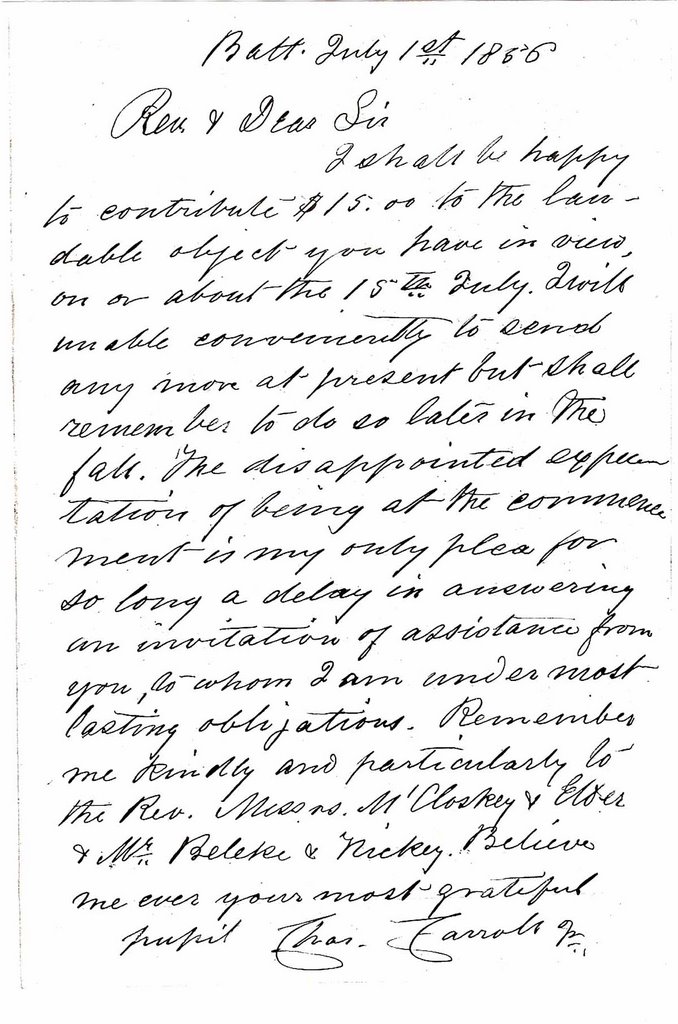
Charles Carroll letter July, 1856


Source: Rev. John McCloskey letters, Special Collections, Mount St. Mary's University. McCloskey was endeavoring to build a new church at Mount St. Mary's.

Balt. July 1st 1856
Rev & Dear Sir
I shall be happy to contribute $15.00 to the laudable object you have in view, on about the 15th of July. I will (be) unable to send any more at present but shall remember to do so later in the fall. The disspaointed expectations of being at the commencement is my only plea for so a dely in answering an invitation of assistance from you, to whom I am under most lasting obligations. Remember me kindly and particularly to the Rev. Messrs McCloskey and Elder & Mr. Beleke & Nickey. Believe me ever your most grateful pupil Chas. Carroll Esq

Labels:

Col. Charles Carroll letter Sept., 1856


Source: Mount Saint Mary's University Special Collections, from Charles Carroll to Rev. John McCloskey. The contribution was for a gothic church Rev. McCloskey planned to erect at the Mountain which never actually materialized.

Baltimore 11th

Dev. & Dear Sir
I enclose to you $20.00 as a small offering to the church you are about to erect. I have not been able to send you any until lately & if I can I will add to my little donation during the Fall. Give my best regards to each of the reverend gentlemen and also to Mr. Beleka. Mr. Verot has just completed a church in our neighborhood, to which we must all contribute, but I will endeavor to raise something for the Mountain church, as I love everybody and everything connected with my old home. I must get up to see you this October. I remain sincerely your devoted pupil

Chas Carroll
Sept 11th 1856

Labels:

Monday, September 04, 2006

Col. Carroll's Letter Oct. 29, 1848


Col. Carroll has relented on his decision not to send John to any northern schools (see below) but is keeping him in the Catholic system. St. Mary's College was in Baltimore. Bishop Hughes was Archbishop John Hughes of New York City who invited the Jesuits to begin a college called St. John's College at Fordham, now Fordham University. The school opened in 1841. Though the letter originated at Doughoregan Manor in Maryland, Colonel Carroll seems to have been spending a lot of time in New York City.
Ironically, John Lee Carroll became one of the most active alumni of Mount St. Mary's and frequently spoke at graduation there. He seems to have chafed under the stern discipline as a young man.
Source of letter: Mount St. Mary's University Special Collections, letter to Rev. John McCloskey.

Doughoregan Manor
Oct. 29, 1848

Rev'd Dear Sir
I owe you an apology for this delay in relation to the (account?) forwarded. I have never been so much employed and have also been much away from home.
You will see in the check forwarded that I have estimated only three months instead of six for John. I fear that I shall have to withdraw him and send him to St. Marys or to Bishop Hughes college in NY. To any of the Northern colleges I will not let him go although he wishes it-- I know them and the dissipation practiced there by experience--Will you do me the favor to see him, communicate this to him, and tell him how deeply I am hurt with him for his discontent, for I am satisfied that your institution is the best at taking things into consideration, (and) he must deport himself as to leave an agreeable association with his name--with my best respect to Mr. Caffrey and the other gentlemen at the college believe me with much respect
Yours Sincerely
Charles Carroll

P. S. Charles was delighted with his visit to the Mountain and has a great regard for the institution and the gentlemen in it--he had the chance of going there or to N. York with us.

Labels:

Charles Carroll letter January, 1848


Addressed to Reverend John McCloskey, Mount St. Mary's College, near Emmitsburg, Maryland.
Rev. McCloskey was prone to punitive methods with the students, the most severe being locking them up in what was called the "jug"--a dark closet--where they would be fed only bread and water by the janitor. One student was locked up for three days for refusing to study Greek. It is unclear what sort of "check" Rev. McCloskey had in mind for John Lee Carroll. McCloskey's harsh methods would lead to a student revolt in 1858 in which about 60 of the students walked out. The ringleader was a distant relation of our Carrolls named Philip Carroll. He was barred from ever coming back to the campus.
Colonel Carroll refers to being unwilling to send John to a northern college because of the perception that northern colleges were hotbeds of dangerous secularism and vice. The Colonel would ultimately relent about this and John Lee Carroll would spend two semesters studying law at Harvard.
Source: Special Collections, Mount Saint Mary's University, Emmitsburg, Maryland

Doughoregan Manor
Jan 25 1848

Revd Dear Sir
I enclose you my check for the amt (amount) of the (unreadable) just received.
I do not think John is inclined to vice, but his spirits are high, and a check of this kind may be of advantage to him--I do not wish to send him to any of the Northern colleges if I can avoid it; for although the advantages of acquiring knowledge are great, the temptations are numerous, and the discipline not good--Principles imbibed now at Mt. St. Mary's will show in after life, if not at present--With my best respects to Mr. McCaffrey I remain now
Yrs Resply (Yours Respectfully)

Charles Carroll

Labels:

Col. Charles Carroll letter 1848


The letter is addressed to Rev. John McCloskey at Mount Saint Mary's College, near Emmitsburg, Md. Source: Special Collections, Mount St. Mary's University. At this point, John Lee and Charles were both attending school there. The event to which their father probably refers was the annual awards banquet at which premiums were given. At this point, Charles was 20 and John Lee 18 years old.

Doughoregan Manor
March 5, 1848

Revd Dear Sir
Enclosed is my check for the amount of Charles' Bill--
It would have given great pleasure to have been with you on the occasion (of) your celebration, & to have seen my Sons acquit themselves with honor to their Professors credit to themselves--a boy's future destiny is often foreshadowed by his character & conduct in college & mine are reaching that age which begins to give hopes & anxieties--
I shall have the pleasure of seeing you I hope at the Mountain to which many of my earlier associations of tranquility & pleasure (exist?)
I am very Resply (Respectfully)
yrs Charles Carroll

Labels:

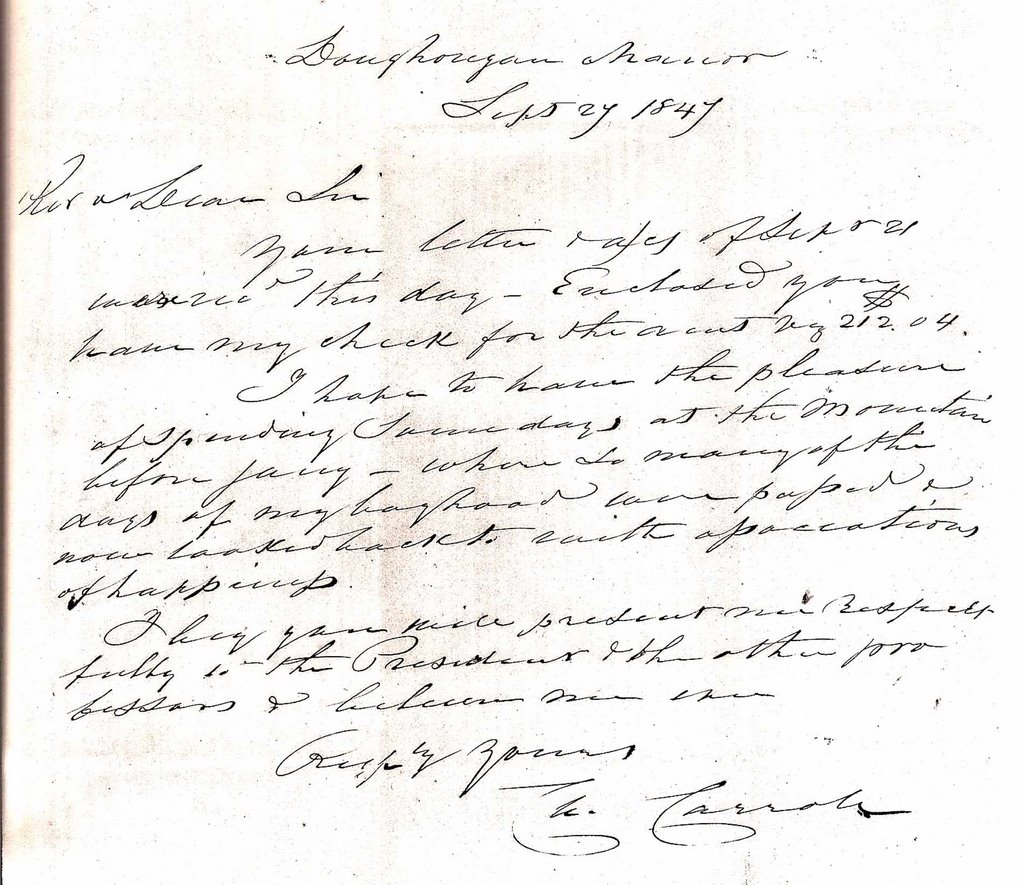
Colonel Charles Carroll's Letter to Rev. John McCloskey


Rev. McCloskey was a priest at Mount Saint Mary's College in Emmitsburg, which both Charles and John Lee attended. I believe this check is for John Lee alone, though records are unclear. As Colonel Carroll indicates, he had attended Mount St. Mary's College as a young man, at the same time that Jerome Bonaparte, son of Jerome Bonaparte and Elizabeth Patterson Bonaparte had attended, a relationship that led to a friendship between the families that continued to the next generation. (see below for the story of Elizabeth Patterson.) Alumni of Mount St. Mary's then and today refer to it as "the Mountain". Source: Special Collections, Mount St. Mary's University.

The text reads:
Doughoregan Manor
September 27, 1847
Revd Dear Sir
Your letter and (unreadable) of Sept. 21 received this day--Enclosed you have my check for the amount of $212.04.
I hope to have the pleasure of spending some days at the Mountain before Jany (January)--where so many of the days of my boyhood were passed & now looked back to to with appreciation and happiness.
I beg you will present my respect fully to the President & the other professors & believe me (unreadable)
Resp'ly (Respectfully) yours
Ch. Carroll

Labels:

Sunday, September 03, 2006

Colonel Charles Carroll's letter to Georgetown Unversity, 1855

Historical Context: Loyola University in Baltimore was founded as a college by nine Jesuits in 1852. Because both Loyola and Georgetown were Jesuit institutions, they followed the same academic program. Harper would not graduate from Georgetown because he lacked a few academic credits to finish with his class in 1858.

Georgetown University Archives, January 3, 1855, to Reverend Bernard A. Maguire, S. J., president of the College

Revd Dear Sir
My son Harper came home from Georgetown with a cough and I found he has been frequently in the Infirmary at the College this fall from the same cause-- our family Physician thinks it would be advisable to withdraw him from the college for three months--He is growing fast and seems to be delicate in health particularly as respects his breast, and the exposure and discipline of a College, so excellent generally for the health and aquirment, does not seem to suit his case at present--Next winter he will be stronger. I wish him to graduate at Georgetown, and in order that he may for three months keep up to all the studies of his class, I have seen Mr. Early and find that Loyola College is but one block from us [and] he can continue precisely the same studies, in the same class and books, as he has just left at Georgetown.
I herewith enclosed to the Revd Mr. Clark a note requesting him to have packed up at once Harper's clothes, and books, and have them forwarded to my resident at Number 46 Mount Vernon Square.
I am respectfully yr Serv't
Charles Carroll

Labels:

Sunday, May 14, 2006

Editorial on Slavery Commending Col. Charles Carroll

Editorial in The Catholic Mirror against Emancipation, quoting Col. Charles Carroll with approval: The Catholic Mirror, February 28, 1863, p. 4.

(Historical Context: Maryland Catholics tended to believe that slavery was Biblical and beneficial to the slave, if not the slave-owner. This editorial was not signed, but would not have been published without the approval of Archbishop Francis Patrick Kenrick of Baltimore, because The Mirror was the official organ of his diocese.)


“THE TRUE FRIENDS AND ENEMIES TO THE SLAVES”

“Two years ago, there was not a happier people on earth than the slaves, as a body, in our Southern States. Of course, in making such an assertion, we mean to compare class with class always. We can readily understand the horrible idea of a New England farmer in supposing himself and his wife and children to be reduced to the hard fate of slavery; and we suppose that his mental comparison makes the slaves what he and his would be transplanted to their position. . . . .


The Southern slaves were born to their lot; and they and their fathers before them were slaves, so far as we can trace their history. What more cruel or abominable slavery can there be on earth than that which yet exists among the African tribes themselves? What man, like the king of Dahoney, sheds the blood of thousands of human victims in honor of the manes of his fathers? Have the American slaves been degraded by being placed in their present condition? Surely not. But have they not been elevated by it? Let any sane man compare their condition with that of the mass of African negroes, or even with the emancipated negroes of the West Indies, and he will find it as clear as day-light, that they have been elevated, vastly elevated.


Now, we say, many American slaves are as good Christians as any living man. In the Catholic Church, they are taught sedulously all the truths of Christianity. They are taught that, though their bodies be dark, their souls, when free from sin, are white and unspotted, and that in the world to come, they will find the portals of heaven as open to them as to their masters. From our earliest infancy to this day, we have participated with slaves in family prayer, and in the reception of the holy sacraments of the Church. We have knelt side by side with them at the foot of the altar; we have prayed for them when living; we have prayed for them dead; and we have asked their prayers likewise. In childhood we took lessons in Christian doctrine in their midst; what has been taught to us has been taught to them. The difference in worldly condition, it is perfectly understood, makes no difference in the eyes of our common Lord and Master, who assigned to us respectively, our places here, and who will assign to the place hereafter, not in relation to present condition, but in relation to fidelity in His service.


We do not wish to put any false gloss upon slavery. It is a hard lot for any human being. But so is a life of poverty, labor, deprivation, and destitution, and yet such is the lot of untold millions who are called free. The American slave, so far, has never known destitution; starvation has never stared him in the face; gaunt famine is altogether unknown—He rarely lives a life of excessive labor. As a general rule in all America, two hired white laborers will do quite as much work as three slaves,--not infrequently thrice as much.—Slave labor is not even economical, as most slave-owners well know.


We would call attention to an extract from the will of one of our most eminent citizens, and largest slaveowners, recently deceased, going the rounds to our daily papers:


‘I have always regarded slavery as a great evil, producing injury and loss in grain-growing States, to the whites principally,--an evil for which we are not responsible who now hold slaves, considering that God in His wisdom, placed them here, or permitted them to be introduced. My experience and full convictions are, that as long as we have that class of labor among us, there are as a mass better cared for and happier, than if they were free and providing for themselves. I therefore give all my slaves to my children, with these positive injunctions: that none of them shall be sold except among themselves, and except for those crimes for which they would be purchased by the laws of the State, and for gross insubordination. I also direct that they shall continue to have the advantages of the religious instruction they now receive, and their morals and habits be watched over like those of children. (Italics ours—Eds., Mir.) It may hereafter be found avisable to move them to the South to cultivate cotton, where the climate is more congenial to their health, while it removes them from the pernicious influences of the low whites who now corrupt them. In this way they may be made profitable, and eventually a fund provided to establish them at some future day in Africa or the West Indies. It is my wish that my children shall not transmit them to any of my grandchildren.” (From the Will of Col. Charles Carroll, of Doughoregan Manor.)

This is the language of the Old-School Catholic gentleman, and of the great slave-owner. This is spoken in the spirit of the Church, in the spirit of humanity, in the spirit of Christian benevolence.

How different the animus from that which pervades the destructive and malignant school of the Abolitionists! A Governor of Massachusetts would have the negroes turned loose upon their masters to slay them and their families, but he warns these negroes that though they escape from slavery, they shall find no home in Massachusetts! He counsel leads the poor creatures only to their own destruction. And he is but a typical man of his party. Cruel, bloody, heartless, these men—Andrews, Sumners, Butlers—wage a double war upon the whites and blacks of the South—trumpeters of destruction—while they take care to keep their own persons far away from the dangers they are so ready to invoke upon others, to carry out their mad and wicked designs.”

Labels:

Journalist William Russell visits Doughoregan, Fall of 1861

Account by William Russell, special correspondent of the London Times, of a visit to Doughoregan.

(Although Col. Carroll is not named in this article, William Russell names him elsewhere. Russell had made his name reporting on the Crimean War and would spend months in 1861 and 1862 touring North and South. The British subject had become “infamous” in the estimation of the Lincoln administration only a few months before this article by his blisteringly accurate account of the way in which the Federal troops broke and ran at Bull Run. William Russell was horrified by what he saw of American slavery in places like Louisiana, but was softened somewhat by his visit to Doughoregan. The “blow” Marylanders had sustained was the imposition of martial law and the crackdown against all States Rights elements in Maryland.)

The article was also in the London Times and reprinted widely, though without identifying the slave-owner in question. There are some differences in each version, and this is the most complete from the point of view of a portrait of the colonel and his land.

From The Catholic Mirror, November 2, 1861, p. 4.

“It is but a month since I was driving through magnificent undulating fields, hemmed in by broad belts of forest, and heavy with crops of Indian corn and tobacco. The rough wooden and brick huts huddled together in the neighborhood of the country seats were peopled by men, women and children with black faces, but for which they might have done duty easily for Hungarian or Lithuanian peasantry, attired in uncouth cloths and great lumbering boots, shuffling and hulking through the fields as if in search of moonstones. Their master, a good, easy, kind-hearted gentleman, polished and well-read, looking on them very much as the Irish squires of the old time regarded squatters—creatures who ought to be useful, who were not profitable, who had no business to be where they were, and who, nevertheless, could not be got rid of without imputations of cruelty which would make him be odious in the land. He was perfectly satisfied the free labor of whites would be more profitable, but what was he to do with his blacks? Where was he to get even the white labor he wanted?


With these sentiments, he felt bitterly the insults of the abolitionists who called him a slave-driver or “nigger breeder”. In his case, most of the fathers of these blacks had been transmitted to him by his ancestors, and had lived as families on the estate for several generations. To look at the fields, luxuriant with weeds and filled with stones, was to be satisfied the system of agriculture was patriarchal if the system of labor was not. But in fact, their condition was very different from that of the slaves on the Southern plantation. The proprietor of these broad domains is is, like many of the Maryland gentry, a Roman Catholic, and a priest, belonging to a religious and educational institution founded by the piety of his forefathers, is engaged to look after the religious welfare of his flock, and I saw a full congregation of the slaves trooping through the meadows t chapel, looking, in their gay dresses and natural groupings, very unlike the beings who are cribbed up like rabbits in the hatches of the South.


Then, after service was over, came the flocks of wooly-headed children of both sexes to the priest, for examination in the Catechism. The houses in which they lived were larger and better than the slave quarters on most plantations, but were not cleaner or more tidy, and it appeared to me as if the inhabitants were a little less respectful in their demeanor. In the name of crinoline, yellow shawls, pink and white dresses, wonderful bonnetry and very quaint-looking, how did the proprietor afford to turn out such gay nymphs of Africa? He did not afford it at all.—Grant that home-reared chickens and pigs paid for some of it, still enough came out of his pocket, in addition to feeding and supporting them, to leave very little between their labor and positive loss. It was no use to call them early, for they dawdled about the fields all the more. Here, in fact, was a state of things which would soon cure itself, if let alone.


The greater part of the estate, indeed, was farmed out to others, on the principle of one-half or one-third of the produce in lieu of rent, and I suspect that was far the most profitable mode of dealing with these wide-spread acres. I am assured that there are many estates in Maryland in the same condition. It may be imagined how their proprietors resent the propaganda which threatens to ruin them utterly, and how this last blow, dealt at the Legislature of the State in which they feel so much pride, is felt by men as tenacious and haughty as any Magyar or Pole who ever lived. If there be any large Union element in Maryland, let it be developed now, or the world will not believe in its existence.”


Although Russell does not identify Col. Carroll as the “gentleman” to whom he spoke about Confederate relatives, the article may answer some questions about exactly when and how Harper and Albert left for Virginia. Harper was a member of the Howard County Dragoons, a militia unit commanded (I believe) by his father and whose captain was George Gaither, with whom Harper would go across the river to the Confederacy. The “General at Baltimore” was likely Benjamin Butler; "Beauregardism” refers to the hero of Sumter and Manassass, P. G. T. Beuregard, who had pledged to some Baltimore belles to plant the Confederate flag atop Monument Square in that city.


This account is in the same article:

“Some considerable towns have spring up in the State recently which are the rallying points for the Union men, and which are thorns in the side of the country gentlemen; but, generally speaking, the majority of the people in most of the counties are opposed to the Government, and there are few landed proprietors who are not Southern Rights men. Many families have representatives in the army of the Confederate States, and all the efforts of the Federalists have not sufficed to prevent intelligence and aid from being sent across the Potomac into Virginia, and could not frustrate the attempts of bodies of armed gentlemen and others, on horse and on foot, to join their friends.

It was only the other day I was speaking to a gentleman who mentioned that he had a large number of relatives in the Southern army, as if it were a matter of common notoriety. ‘And how did they get there?’ Why they belonged to a body of cavalry which we have had for many years composed of the young gentlemen of the country to keep down negro insurrection. They hear one night that the negroes were going to rise, and appearances justified the rumor. So they assembled and sent in word to the General at Baltimore that they had met, and that they would probably require some aid. He ordered them at once to disband or to wait till he sent out an officer to make each of them take the oath of allegiance. Deeply offended by this conduct, nearly all of them rode off, crossed the river that night and joined the enemy. The women have embraced Beauregardism with the greatest devotion, and their beauty and grace render them powerful proselytizers.

It may be true that the State has been nearly disarmed by frequent and rigid searches, but if there are not bows, and flags and rosettes of the orthodox colors forthcoming in profusion whenever the Confederates make their appearance, I am much deceived at the ingenuity and zeal of the fair Marylanders.”

Labels: ,

Requiem Mass for Col. Charles Carroll

Requiem Mass for the Repose of the Soul of Col. Charles Carroll

(Col. Carroll died less than three months after his son, Albert . Colonel Carroll’s wife, Mary Digges Lee, had passed away only a few years earlier. The author makes oblique reference to the absence of the youngest son, Harper, who had left for Virginia to fight for the Confederacy. The writer does not mention the fact, but the announcement of Col. Carroll’s death was in the same issue of The Catholic Mirror as that of his relative, Lady Stafford of England, another granddaughter of Charles Carroll of Carrollton. It was Lady Stafford who had urged her grandfather to endow St. Charles College. St. Charles College was built on Carroll land in Howard County and conferred minor orders on priests. It would burn in 1911 and was removed to Catonsville. Harper took the Catholic Church to court to recover the land, as the will of Charles Carroll of Carrollton specified that if the Church ceased to use it, it would revert to the family.)

From The Catholic Mirror, December 27, 1862, p. 5. “Testis” is Latin for “witness”.


Messrs. Editors—One of the most solemn and imposing rites of the Catholic Church—the Requiem Mass—was celebrated on Tuesday, the 16th inst., for the repose of the soul of the late lamented Col. Charles Carroll, of whose death your readers are doubtless cognizant, in the chapel attached to his country seat, Doughoregan Manor, Howard county, Md. The services were conducted by the reverend gentlemen and students connected with Charles College, the Rev. Mr. Dennis officiating as celebrant, assisted by the Rev. Messrs. Chapius and Rince as deacon and sub-deacon. The choir was composed of a select number of students under the direction of the Rev. Mr. Menu, and the creditable manner in which the sublime music of the Gregorian chant was sung, added much to the solemnity of the occasion. The worthy pastor of the congregation attending the chapel, the Rev. Mr. Griffin, made a brief, but impressive, discourse on the merits and character of the deceased, alluding, in a particular manner, to the munificence displayed by him in enlarging and beautifying this sacred edifice which will be a lasting monument of the zeal which he manifested for the glory of God and the cause of religion. The Mass was attended by the bereaved relatives, and by a large number of the deceased’s friends, who came to offer up their prayers, in union with those of the Church, and to pay this last tribute of affection to the memory of him who claimed the respect and esteem of all. In concluding this brief and incomplete description of this solemn and interesting ceremony, we sincerely condole with the members of this estimable family for the severe losses which they have recently sustained from the visitation of death, having been called upon, within a comparatively short period, to lament the demise of a mother, brother, and lastly of a much-loved father.

It might be supposed, Messrs. Editors, that, in this retired and thinly peopled portion of Maryland, the dire effects of the unnatural struggle, which is now decimating our unhappy country, would not be so keenly felt as in the crowded and populous city; but the absence of many a young and promising member from our humble congregation on Sundays, proves that, though removed from the active scenes of war, we are not exempt from its baneful influences. May the Most High, in the infinitude of His mercies, deign to hear the prayers of a suppliant people for the blessings of peace, and may the new year usher in a new era of happiness and prosperity for our country!

Respectfully yours,

TESTIS

Labels:

Death Announcement of Charles Carroll of Doughoregan


(The Catholic Mirror, December 6, 1862, p. 6.)

Death of Col. Charles Carroll of Doughoregan Manor.

With feelings of deep regret we announce the death of COL. CHARLES CARROLL, who departed this life of the 2nd instant, in his 62nd year. Deceased was a worthy scion of illustrious sires, whose names are identified with the history of our State and country almost from their foundation. Patriotism, charity, and hospitality, as practiced so eminently by his world-renowned grandfather, Charles Carroll of Carrollton, were dutifully perpetuated by the lamented deceased. We sincerely condole with his bereaved family and many friends, for their irreparable loss. May his soul rest in peace.

Labels:

Tuesday, February 28, 2006

R. S. Ewell letter to Col. Charles Carroll, 1850


Historical Background:

Richard Stoddard Ewell was a graduate of West Point who had fought as a First Lieutenant in the Mexican War, where he served with Captain Robert E. Lee. The first time Ewell was under fire was when Lee took Ewell’s company as a covering force. After the war, Ewell and Lee deepened their friendship when the former served fourteen months in Baltimore, allowing him to call frequently upon now Brevet Colonel Robert E. Lee who was engaged in building a fort that in 1850 would be named Fort Carroll, after Charles Carroll of Carrollton. Ewell had many relatives in Maryland, and doubtless made the acquaintance of the Carroll family at that time, if not earlier. This connection would be important at the outbreak of the Civil War for the younger sons of Colonel Charles Carroll, Albert and Harper, both of whom would serve on his staff.

After Baltimore, Ewell was sent to the western frontier to keep the local Apaches, Utes, and Navajos from attacking the American settlers, as well as overseeing a population of Mexicans who had little use for their recent conquerors. Rayado was a stagecoach stop on the Santa Fe Trail and is marked by spectacular scenery of mountains and desert.

Rayado N. Mexico

Feb.y 1st 1850

Col. Charles Carroll

Doughoregan Manor, Md.

Dear Sir;

The only excuse I can make for this annoyance is, that in this lovely region we think a great deal of those from whom we have received kindness when in the world and there are non to whom I am more anxious to express my gratitude to than to yourself and your family, Besides when I last saw you in Balt. On my way to Richmond Va. you told me to make a military report from that place on subjects relative to Cavalry and Joffer that order as an excuse.

This Port is occupied by two camps of dragoons under Brt Maj and Cap. Grier and is about 160 miles nearer the states than Santa Fe, holding somewhat in check some of the worst Indian tribes of the side of the territory of New Mexico. I wish I could give you an account of an Indian fight, but not having been in any yet must postpone that pleasure. I copied the plans last Fall from Fort Leavenworth Mo. With 150 raw recruits, mounted and having to escort a wagon train, was two months in arriving at my port. The only incident on my march was meeting the celebrated Kit. Carson with a small escort of dragoons in pursuit of a wagon train. It seems that Sam’l Wethered of Balt. and other merchants were riding to the states with a large amount of specie and that a plot had been formed, or there was good reason to suppose one had been by one of the men with the train to raise the alarm of Indians and murder these men for their money---? had followed with the small det. to warn the merchants of their danger and arrest the suspected men.

As there were more than forty men with the train I deemed his party too small and ret’d with a detachment from my command overtaking the wagons late at night. We concealed our object pretending to have come from another direction and informing Wethered of our intentions, he pointed out the man lying asleep and we were so fortunate as to arrest and carry him back without resistance. I was considerably relieved as it was thought had our intentions been known there would have been bloodshed. I have seen the affair mentioned in some of the papers in which we are credited with having rode 128 miles in 24 hours!!!! Some of us though were in the saddle nearly 30 hours out of 36. But every person of the plains enjoys such health that they are much more capable of great exertions than in ordinary times.

This country of N.M. has agreeably disappointed me in regard to its resources. It is unequalled as a growing section, the group even now, that it has been long dead is very nutritious; cattle keeping fat all the winder without the diseases they are liable to in the states, Wool is worth from 1 to 2 cents per lb, it is coarse, as a farmer told me the other day, sheep never did here—The mutton is peculiarly find—The land generally requires irrigation to produce grain, but very little of that suffices in a growing country and from thirty to fifty bushels I am told is an average crop. The climate is remarkable for its salubrity (sic), every one enjoys good health. Some day or other we will have an attack of the gold mania here and nothing but the apathy of the Natives has prevented it before. I heard that a Mexican had, in riding along a stream in the Taos Valley, picked up $17.00 worth without any delay in his journey, and a short time since a man in crossing a stream in this neighbourhood carried home a little sand in his handkerchief as an experiment out of which he took about one dollars worth, I must confess that in all my wanderings I have not seen the first particle.

We have some game about here, grizzly bear in the summer, at this time antelope two varieties of deer, ducks &c & c. You may wonder with all this to occupy myself with that I should pester you with a long letter, but my abrupt departure prevented my taking leave of your family as I wished to have the honor of doing and this infliction is some alleviation. May I ask you to give my respects to Mrs. Carroll and the young ladies?

With remembrance to Charles I remain & c.

R. S. Ewell.

P. S. I came near omitting the “tactics”. We have a fine squadron which is being drilled ? chiefly under the imperintendance ? of your humble servant, and I often think of our discussion over the book. I want to go to Europe if they would let me and re-moddle (sic) them for they are undoubtedly deficient. We depend for horses on the ? and consequently are not always well provided—They could raise fine horses here, though has yet they have only ponies.

Yours & c—

R. S. E

Labels:

Friday, February 24, 2006

Slave Census for Charles Carroll of Doughoregan in 1860

Charles Carroll kept three slaves at his home in Baltimore, but the remaining 76 slaves were in Howard County, presumably at Doughoregan Manor, though some may have been at outlying farms. They ranged in age from a male and female aged 71 to four 1 year old children.

50 Male Black Charles R Carroll Baltimore City Ward 11, Baltimore, Maryland
45 Male Black Charles R Carroll Baltimore City Ward 11, Baltimore, Maryland
27 Male Black Charles R Carroll Baltimore City Ward 11, Baltimore, Maryland
71 Male Black Charles Carroll District 2, Howard, Maryland
71 Female Black Charles Carroll District 2, Howard, Maryland
69 Male Black Charles Carroll District 2, Howard, Maryland
68 Female Black Charles Carroll District 2, Howard, Maryland
65 Male Black Charles Carroll District 2, Howard, Maryland
63 Male Black Charles Carroll District 2, Howard, Maryland
62 Male Black Charles Carroll District 2, Howard, Maryland
62 Female Black Charles Carroll District 2, Howard, Maryland
60 Male Black Charles Carroll District 2, Howard, Maryland
57 Male Black Charles Carroll District 2, Howard, Maryland
52 Male Black Charles Carroll District 2, Howard, Maryland
50 Male Black Charles Carroll District 2, Howard, Maryland
49 Female Black Charles Carroll District 2, Howard, Maryland
48 Male Black Charles Carroll District 2, Howard, Maryland
44 Male Black Charles Carroll District 2, Howard, Maryland
38 Female Black Charles Carroll District 2, Howard, Maryland
37 Male Black Charles Carroll District 2, Howard, Maryland
36 Female Black Charles Carroll District 2, Howard, Maryland
36 Male Black Charles Carroll District 2, Howard, Maryland
33 Male Black Charles Carroll District 2, Howard, Maryland
32 Male Black Charles Carroll District 2, Howard, Maryland
32 Female Black Charles Carroll District 2, Howard, Maryland
32 Female Mulatto Charles Carroll District 2, Howard, Maryland
31 Female Black Charles Carroll District 2, Howard, Maryland
30 Female Black Charles Carroll District 2, Howard, Maryland
30 Male Black Charles Carroll District 2, Howard, Maryland
29 Male Black Charles Carroll District 2, Howard, Maryland
27 Female Mulatto Charles Carroll District 2, Howard, Maryland
26 Female Black Charles Carroll District 2, Howard, Maryland
21 Male Black Charles Carroll District 2, Howard, Maryland
20 Female Black Charles Carroll District 2, Howard, Maryland
19 Male Mulatto Charles Carroll District 2, Howard, Maryland
19 Male Black Charles Carroll District 2, Howard, Maryland
18 Female Black Charles Carroll District 2, Howard, Maryland
17 Male Black Charles Carroll District 2, Howard, Maryland
16 Male Black Charles Carroll District 2, Howard, Maryland
16 Female Black Charles Carroll District 2, Howard, Maryland
16 Male Black Charles Carroll District 2, Howard, Maryland
15 Male Black Charles Carroll District 2, Howard, Maryland
13 Female Black Charles Carroll District 2, Howard, Maryland
12 Female Black Charles Carroll District 2, Howard, Maryland
10 Female Black Charles Carroll District 2, Howard, Maryland
10 Male Black Charles Carroll District 2, Howard, Maryland
9 Male Black Charles Carroll District 2, Howard, Maryland
9 Female Black Charles Carroll District 2, Howard, Maryland
8 Male Mulatto Charles Carroll District 2, Howard, Maryland
8 Female Mulatto Charles Carroll District 2, Howard, Maryland
7 Female Black Charles Carroll District 2, Howard, Maryland
5 Male Black Charles Carroll District 2, Howard, Maryland
5 Female Black Charles Carroll District 2, Howard, Maryland
4 Female Black Charles Carroll District 2, Howard, Maryland
4 Female Mulatto Charles Carroll District 2, Howard, Maryland
4 Male Black Charles Carroll District 2, Howard, Maryland
4 Female Black Charles Carroll District 2, Howard, Maryland
3 Male Black Charles Carroll District 2, Howard, Maryland
3 Female Black Charles Carroll District 2, Howard, Maryland
3 Male Black Charles Carroll District 2, Howard, Maryland
2 Female Black Charles Carroll District 2, Howard, Maryland
1 Male Black Charles Carroll District 2, Howard, Maryland
1 Female Black Charles Carroll District 2, Howard, Maryland
1 Male Black Charles Carroll District 2, Howard, Maryland

Labels: